Working Papers
|
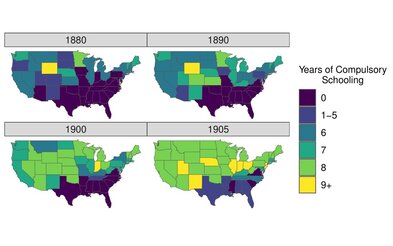
Using linked records from the 1880 to 1940 full-count United States decennial censuses, we estimate the effects of parental exposure to compulsory schooling (CS) laws on the human capital outcomes of children, exploiting the staggered roll-out of state CS laws in the late nineteenth and early twentieth centuries. CS reforms not only increased the educational attainment of exposed individuals, but also that of their children. We find that one extra year of maternal (paternal) exposure to CS increased children’s educational attainment by 0.015 (0.016) years - larger than the average effects on the parents themselves, and larger than the few existing intergenerational estimates from studies of more recent reforms. We find particularly large effects on black families and first-born sons. Exploring mechanisms, we find suggestive evidence that higher parental exposure to CS affected children's outcomes through higher own human capital, marriage to more educated spouses, and a higher propensity to reside in neighborhoods with greater school resources (teacher-to-student ratios) and with higher average educational attainment.
HECO Working paper |
|
Publications
|
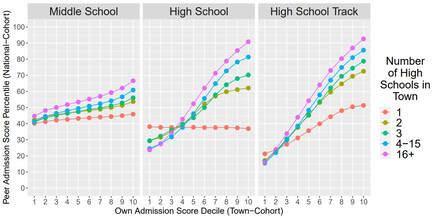
This study examines the impact of school choice on academic achievement. I use differences in the number of schools across similar Romanian towns, generating variation in school choice for local students, who compete for seats via test scores. I find that more school choice results in increased sorting of students by admission scores across different schools. Sorting widens achievement gaps between high- and low-admission score students. High-scorers having access to better teachers and peer effects are the primary factors explaining these widening gaps. Lastly, between-school competition via school choice does not increase average achievement levels.
|
|
"How cooperative is “cooperative federalism”? The political limits to intergovernmental cooperation under a de facto concurrency rule." (with Christa Scholtz) Constitutional Political Economy 34.1 (2023): 111-134.
In progress...
- The Effect of High School Majors - with Robert Ainsworth, Rajeev Dehejia, Cristian Pop-Eleches and Miguel Urquiola
- The Equilibrium Implications of Identity Choice: Education, Passing, and Perceptions of the Roma People - with Margareta Matache, Gabriel Kreindler, Andreea Mitrut and Cristian Pop-Eleches
- The Effects of Attending a Higher Value-added High School - with Robert Ainsworth, Rajeev Dehejia, Cristian Pop-Eleches and Miguel Urquiola
- Survival of the Fittest? School Closures and Expansions in a Centralized Choice System - with Robert Ainsworth, Rajeev Dehejia, Cristian Pop-Eleches and Miguel Urquiola
- The Determinants of Ability Tracking and Its Effects - with Ofer Malamud, Andreea Mitrut, Cristian Pop-Eleches and Miguel Urquiola
- The Unintended Consequences of Shorter Curriculum Length - with Xian Zhang
